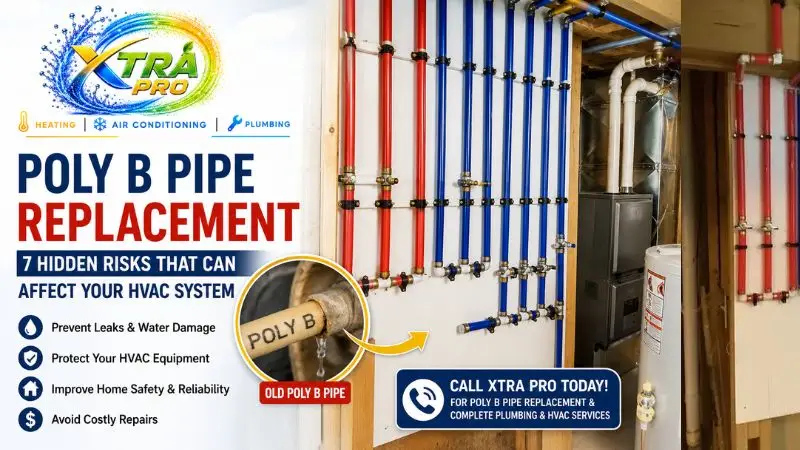
Poly B pipe replacement is often considered a plumbing project, but aging Poly-B plumbing can create problems that extend beyond your water supply system. In homes with older plumbing, a leaking or deteriorating Poly-B pipe can affect areas around furnaces, water heaters, air conditioning equipment, heat pumps, electrical components, insulation, and other mechanical systems.
Poly-B pipes, also known as polybutylene pipes, were commonly used in residential plumbing systems built between the late 1970s and the mid-1990s. Over time, these pipes can become brittle and more vulnerable to leaks, especially when exposed to chlorine-treated water and changing temperatures.
For homeowners, the important question is not simply whether Poly-B plumbing is old. It is whether the piping is creating a risk to the home and its HVAC and mechanical equipment.
If you have Poly-B plumbing, understanding the warning signs, replacement process, costs, and potential HVAC impact can help you make a more informed decision.
What Are Poly B Pipes?
Poly-B pipes are a type of flexible plastic plumbing pipe that was used extensively in residential water distribution systems.
They were popular because they were:
- Flexible
- Lightweight
- Easy to install
- Less expensive than some traditional plumbing materials
- Suitable for residential water supply applications
However, Poly-B piping can deteriorate over time. The material may become brittle, while fittings and connections can also become vulnerable to failure.
A Poly-B plumbing system may still appear functional even when deterioration is occurring inside the pipe. This is one reason homeowners may not realize they need Poly B pipe replacement until a leak or plumbing failure occurs.
Does Polybutylene Pipe Need to Be Replaced?
Polybutylene pipe does not necessarily fail immediately simply because of its age. However, many homeowners choose proactive replacement because the material has a history of premature deterioration and unexpected leaks.
Replacement becomes particularly important when you notice:
- Frequent plumbing leaks
- Discolored or damaged pipes
- Brittle pipe material
- Reduced water pressure
- Water stains around plumbing fixtures
- Recurring fitting failures
- Damp areas near mechanical equipment
- Previous Poly-B pipe repairs
A professional plumbing inspection can help determine the condition of your existing piping and whether replacing the system is appropriate.
Why Replace Poly-B Plumbing?
One of the biggest reasons for replacing Poly-B plumbing is risk reduction.
A failed pipe can release a significant amount of water into a home. Depending on where the pipe fails, the resulting water damage can affect flooring, drywall, insulation, electrical systems, mechanical equipment, and HVAC components.
Replacing aging Poly-B pipes with a modern plumbing material can provide homeowners with a more reliable water distribution system and reduce the possibility of unexpected plumbing failures.
But there is another concern that homeowners sometimes overlook:
A plumbing leak can affect HVAC equipment.
Let’s look at seven ways this can happen.
7 Hidden Risks of Poly B Pipes That Can Affect Your HVAC System
1. Water Leaks Can Damage Furnace Components
A Poly-B pipe located near a furnace can create a serious problem if it develops a leak.
Water can reach electrical components, controls, wiring, sensors, or other furnace parts. Even a relatively small leak can become problematic if water continues to accumulate around the equipment.
Depending on the location and severity of the leak, homeowners may experience:
- Furnace shutdowns
- Electrical problems
- Corrosion
- Damaged controls
- Reduced heating performance
- Expensive repairs
This is why plumbing leaks near mechanical equipment should not be ignored.
2. Water Damage Can Affect HVAC Electrical Systems
Modern HVAC equipment depends on electrical components to operate safely and efficiently.
A leaking Poly-B pipe near an HVAC system can expose wiring, control boards, disconnects, and other electrical components to moisture.
Water and electricity create a particularly serious combination.
Even when HVAC equipment continues working after a leak, moisture can contribute to corrosion and deterioration that may cause problems later.
Professional inspection is important whenever water has reached an HVAC system or its electrical components.
3. Leaks Can Damage Insulation Around HVAC Equipment
Insulation helps maintain temperature control and improve energy efficiency throughout a home.
A plumbing leak can saturate insulation around:
- Ductwork
- Pipes
- Mechanical rooms
- HVAC equipment
- Walls and ceilings
Wet insulation can lose some of its effectiveness and may take considerable time to dry, particularly in enclosed areas.
If the source of moisture is not corrected, replacing damaged insulation alone will not solve the underlying problem.
4. Poly-B Leaks Can Affect Heat Pumps and Air Conditioning Systems
Heat pumps and air conditioning systems often have indoor components located in basements, utility rooms, closets, or mechanical areas.
If a Poly-B pipe fails nearby, water can spread into these spaces and potentially affect HVAC equipment.
For example, water can reach:
- Indoor coils
- Electrical controls
- Drainage components
- Wiring
- Air handlers
- Equipment platforms
This doesn’t mean Poly-B directly damages a heat pump or air conditioner. The risk comes from water released by a failed plumbing pipe interacting with nearby HVAC equipment.
That distinction is important.
5. Water Damage Can Increase HVAC Maintenance Problems
Moisture around HVAC equipment can create conditions that contribute to corrosion, insulation damage, electrical deterioration, and other maintenance issues.
A homeowner may initially notice a plumbing leak but later discover that HVAC performance has also been affected.
This can make the overall repair more expensive because the problem is no longer limited to plumbing.
Replacing deteriorating Poly-B piping can therefore be part of a broader strategy to protect important systems within the home.
6. Hidden Plumbing Leaks Can Damage Walls Around HVAC Ductwork
Not every Poly-B leak happens in an exposed location.
Some pipes run through walls, ceilings, floors, or areas near ductwork.
A hidden leak can continue for an extended period before visible water damage appears.
By the time a homeowner notices:
- Ceiling stains
- Damp drywall
- Musty odors
- Damaged flooring
- Bubbling paint
the surrounding materials may already have been affected.
If HVAC ducts or components are located in the same area, moisture can create additional problems.
7. Major Water Damage Can Increase HVAC Repair or Replacement Costs
The most significant hidden risk is the chain reaction caused by a plumbing failure.
A single failed Poly-B pipe could potentially lead to:
Pipe failure → water leak → water damage → HVAC exposure → equipment damage → additional repair costs
The actual outcome depends on where the pipe fails and how quickly the leak is discovered.
This is why replacing aging Poly-B plumbing can be viewed as more than a plumbing upgrade. It can also be a way to reduce the risk of water damage to other critical home systems.
Replacing Poly B Piping: What Are Your Options?
When replacing Poly-B plumbing, homeowners typically work with a qualified plumber to determine the most suitable replacement material and configuration.
Modern residential repiping may involve materials such as:
PEX
PEX is flexible, lightweight, and commonly used for residential water supply systems.
Copper
Copper has been used in residential plumbing for decades and is known for its durability and longevity when properly installed.
The right material depends on the home’s plumbing layout, existing connections, local requirements, accessibility, budget, and other project-specific factors.
A professional assessment is recommended before choosing a replacement system.
How to Replace Polybutylene Pipes
The Poly B pipe replacement process generally involves several stages.
1. Plumbing Inspection
A professional plumber identifies the location and condition of Poly-B piping throughout the home.
2. System Planning
The replacement route, pipe material, access points, fixtures, and connection requirements are evaluated.
3. Removal of Existing Poly-B
Where practical, existing Poly-B piping is removed or isolated according to the project’s design.
4. Installation of New Piping
The new plumbing system is installed and connected to fixtures and the home’s main water supply.
5. Connection and Testing
The new system is pressure-tested and inspected for leaks.
6. Final Inspection
The plumber verifies that fixtures receive appropriate water flow and that the replacement system operates properly.
The exact process varies depending on the home’s size, construction, plumbing layout, accessibility, and the extent of the replacement.
Cost of Polybutylene Pipe Replacement in BC
One of the most common questions homeowners ask is:
How much does Poly-B pipe replacement cost in BC?
There is no single price that applies to every home.
The cost of Polybutylene pipe replacement in BC can depend on factors such as:
- Home size
- Number of plumbing fixtures
- Amount of Poly-B piping
- Number of floors
- Accessibility of existing pipes
- Wall and ceiling access
- Replacement pipe material
- Labour requirements
- Plumbing configuration
- Restoration work required after repiping
For example, replacing accessible pipes in a smaller home may be considerably different from repiping a larger multi-level property where pipes run behind finished walls and ceilings.
Polybutylene Pipe Cost to Replace: What Influences the Price?
Homeowners searching for Polybutylene pipe cost to replace should look beyond the price per foot of pipe.
The total project cost can include:
Materials + Labour + Access + Connections + Testing + Restoration
This is why professional inspection and an accurate project assessment are more useful than relying on a generic online price.
Poly B Pipe Replacement Cost in Vancouver
The Poly B pipe replacement cost in Vancouver can vary considerably from one property to another.
Vancouver-area homes differ in age, size, construction, plumbing configuration, and accessibility. These factors can significantly influence the labour required for repiping.
A professional plumber can inspect the existing system and provide a project-specific estimate based on the actual condition and layout of the plumbing.
Does Poly-B Replacement Affect Your HVAC System?
Poly-B replacement does not normally require replacing your HVAC system.
However, the plumbing work can take place near HVAC equipment, ductwork, air handlers, furnaces, heat pumps, or other mechanical components.
During a repiping project, professional coordination is important to avoid unnecessarily disturbing HVAC equipment.
If previous Poly-B leaks have already caused water damage, the HVAC system may also need to be inspected.
The key is to treat plumbing and HVAC as interconnected home systems when they share the same mechanical spaces.
How Poly B Replacement Can Protect Your HVAC Investment
Your HVAC system represents a significant investment in your home’s comfort.
Preventing water damage around that equipment can help reduce avoidable repair risks.
Replacing deteriorating Poly-B plumbing can help by:
- Reducing the risk of plumbing leaks
- Protecting mechanical rooms
- Reducing moisture exposure
- Helping protect electrical components
- Preventing water damage around ductwork
- Reducing the possibility of emergency water damage
- Supporting better overall home maintenance
It is important to remember that Poly-B replacement does not guarantee that HVAC problems will never occur. Instead, it addresses one potential source of water-related damage.
Signs You May Need Poly B Pipe Replacement
Consider having your plumbing inspected if you notice:
Leaks: Recurring leaks may indicate deteriorating piping or fittings.
Discoloration: Pipes that appear damaged, brittle, or discolored may require professional evaluation.
Water stains: Stains on ceilings, walls, or floors can indicate a hidden plumbing leak.
Low water pressure: Changes in water flow can sometimes indicate plumbing problems.
Frequent repairs: Repeated plumbing repairs may suggest that replacing the underlying piping is more practical.
Older plumbing: If your home has Poly-B piping, a professional inspection can help determine its condition.
The Benefits of Replacing Poly-B Plumbing
Replacing Poly-B plumbing can provide several potential benefits for homeowners.
Reduced Leak Risk
A properly installed modern piping system can reduce concerns associated with aging Poly-B materials.
Greater Plumbing Reliability
A new system can provide a more dependable water distribution network.
Protection for the Home
Reducing the likelihood of major leaks can help protect walls, floors, ceilings, insulation, and mechanical areas.
Better Long-Term Planning
Instead of repeatedly responding to individual leaks, homeowners can address aging plumbing as a complete system.
Peace of Mind
Knowing that vulnerable Poly-B piping has been replaced can provide greater confidence in the home’s plumbing infrastructure.
Should You Replace Poly-B Pipes Before They Leak?
There is no universal answer for every home, but proactive evaluation can make sense when Poly-B piping is aging, deteriorating, or showing warning signs.
Waiting until a pipe fails can potentially turn a planned plumbing project into an emergency repair involving water damage.
If your home contains Poly-B plumbing, a professional inspection can help you understand:
- What type of piping you have
- Where it is located
- Its current condition
- Whether replacement is recommended
- What replacement options are available
- What the estimated project cost may be
Frequently Asked Questions About Poly B Pipe Replacement
What are Poly B pipes?
Poly-B pipes are flexible polybutylene plastic pipes that were commonly used in residential water supply systems. They were popular because they were lightweight, flexible, and relatively easy to install.
Does polybutylene pipe need to be replaced?
Polybutylene pipe may warrant replacement because of its history of deterioration and leaks. The condition of the piping, its age, location, and previous plumbing problems should be evaluated by a qualified professional.
How do you replace polybutylene pipes?
Replacing Poly-B pipes typically involves inspecting the plumbing system, planning the new piping layout, removing or bypassing existing Poly-B, installing new piping, connecting fixtures, pressure testing the system, and completing final inspections.
How much does Poly-B pipe replacement cost?
The cost varies based on the home’s size, plumbing layout, accessibility, number of fixtures, replacement material, labour, and restoration requirements. A professional assessment is the best way to determine an accurate project-specific estimate.
What is the Poly B pipe replacement cost in Vancouver?
Poly-B replacement costs in Vancouver vary by property. Larger homes, multiple floors, difficult access, and extensive wall or ceiling work can increase project complexity and labour requirements.
Can Poly-B pipes damage an HVAC system?
Poly-B pipes do not directly damage HVAC equipment. However, a failed pipe can release water near furnaces, heat pumps, air conditioners, ductwork, wiring, insulation, and other mechanical components. This water exposure can potentially cause HVAC-related damage.
Should I replace Poly-B plumbing before it leaks?
If your home has aging Poly-B plumbing, having it professionally inspected can help you determine whether proactive replacement makes sense. Replacing vulnerable piping before a major failure may help reduce the risk of unexpected water damage.
Is replacing Poly-B plumbing worth it?
For homeowners concerned about aging or deteriorating Poly-B plumbing, replacement can be a worthwhile long-term investment. It can reduce the risk associated with pipe failures and help protect other parts of the home from water damage.
Why Choose Xtra Pro?
Choosing the right contractor for Poly-B pipe replacement is important because the work involves your home’s entire water supply system. Xtra Pro provides professional residential plumbing and HVAC services with a focus on reliable workmanship, clear communication, and long-term solutions.
- Experienced Residential Professionals: Our team understands the unique plumbing and HVAC needs of homeowners throughout the Lower Mainland, BC.
- Complete Plumbing & HVAC Expertise: Because we provide both plumbing and HVAC services, we understand how plumbing work can affect furnaces, heat pumps, air conditioners, ductwork, and mechanical spaces.
- Professional Poly-B Replacement: We assess existing Poly-B piping and develop a replacement approach based on your home’s plumbing layout and specific requirements.
- Quality Workmanship: We focus on proper installation, reliable connections, system testing, and attention to detail.
- Same-Day & Emergency Service: When an unexpected plumbing problem occurs, our team is available to help address urgent residential plumbing needs.
- Clear, Practical Solutions: We explain the condition of your plumbing, available replacement options, and important considerations so you can make an informed decision.
- Local Residential Service: We serve homeowners across communities in the Lower Mainland, providing dependable plumbing, heating, cooling, and indoor-comfort solutions.
With Xtra Pro heating, air conditioning and plumbing, the goal is not simply to replace aging pipes. We help homeowners build a safer, more reliable plumbing system while considering the surrounding HVAC and mechanical equipment.
Final Thoughts
Poly B pipe replacement is not only about replacing old plumbing it can also be about protecting the systems and structure surrounding that plumbing.
A failed Poly-B pipe can release water into areas containing furnaces, heat pumps, air conditioners, electrical components, ductwork, insulation, and other valuable equipment.
Understanding what Poly-B pipes are, why they may need replacement, the replacement process, and the potential cost allows homeowners to make better decisions before a plumbing emergency occurs.
If your home has Poly-B plumbing, the best first step is a professional inspection. Identifying the condition and location of the piping can help you determine whether replacement is necessary and how the project should be approached.
Need help with aging Poly-B plumbing? Contact a qualified residential plumbing professional to inspect your system and discuss your replacement options.